Flight Model aero parameters working in MSFS 2020, but not in MSFS 2024

Version: 1.3.10.0

Frequency: Consistently

Severity: High
(Low - quality of life, workflow optimization, rare enough to not impact production, etc…
High - critical but workarounds are available, important feature not working as expected, frequent enough to impact production
Blocker - prevents from working on the project, prevents from releasing the product)

Marketplace package name: if applicable

Context: Airplane flight model

Similar MSFS 2020 issue: No issue in MSFS 2020

Bug description:
The flight model "aerodynamics: variables StallDef_StartRatio, StallDef_EndRatio, StallDef_airflowdetachspeed, Stall_AileronAddIncidence, Stall_TipAddIncidence, presspt_fwd_Alpha0_pMAC, presspt_fwd_AlphaStall_pMAC appear to either have no effect or a much different (lesser) effect than in MSFS 2020. In porting a community project MSFS 2020 airplane over to MSFS 2024 where these variables were used to prevent auto-rotation during the takeoff roll and unrecoverable pitch up/stall in flight, they seem to have no such effect in MSFS 2024. The undesired characteristics that were satisfactorily addressed by use of these variables in MSFS 2020 are back in MSFS 2024, with the aforementioned variables no longer having any effect. Is this intended?

This leads me to the obvious question of what other flight model variables have either no effect in MSFS 2024 or a substantially different effect than in MSFS 2020?

2 Likes

Hey, VERY interesting. I’ve been trying to port successful MSFS2020 gliders into 2024 and have been caught out with the stall behaviour changing, so there IS something going on. I posted my issues here: How to get the 2020 flight model in MSFS 2024?

Actually I don’t see that. When I ported a MSFS2020 aircraft to MSFS2024 the stall curve looks exactly the same. Are you sure it’s not something else that upset the pitch?

Hi everyone,

For those of you who are affected by this issue, would it be possible to name the aircraft/packages that you encountered the problem with? Does the MSFS2020 package behave “normally” in 2024? Does the issue occur when you are moving from an 2020 package to a 2024 package?

Thanks a lot for your reports.

Best regards,

Eric / Asobo

1 Like

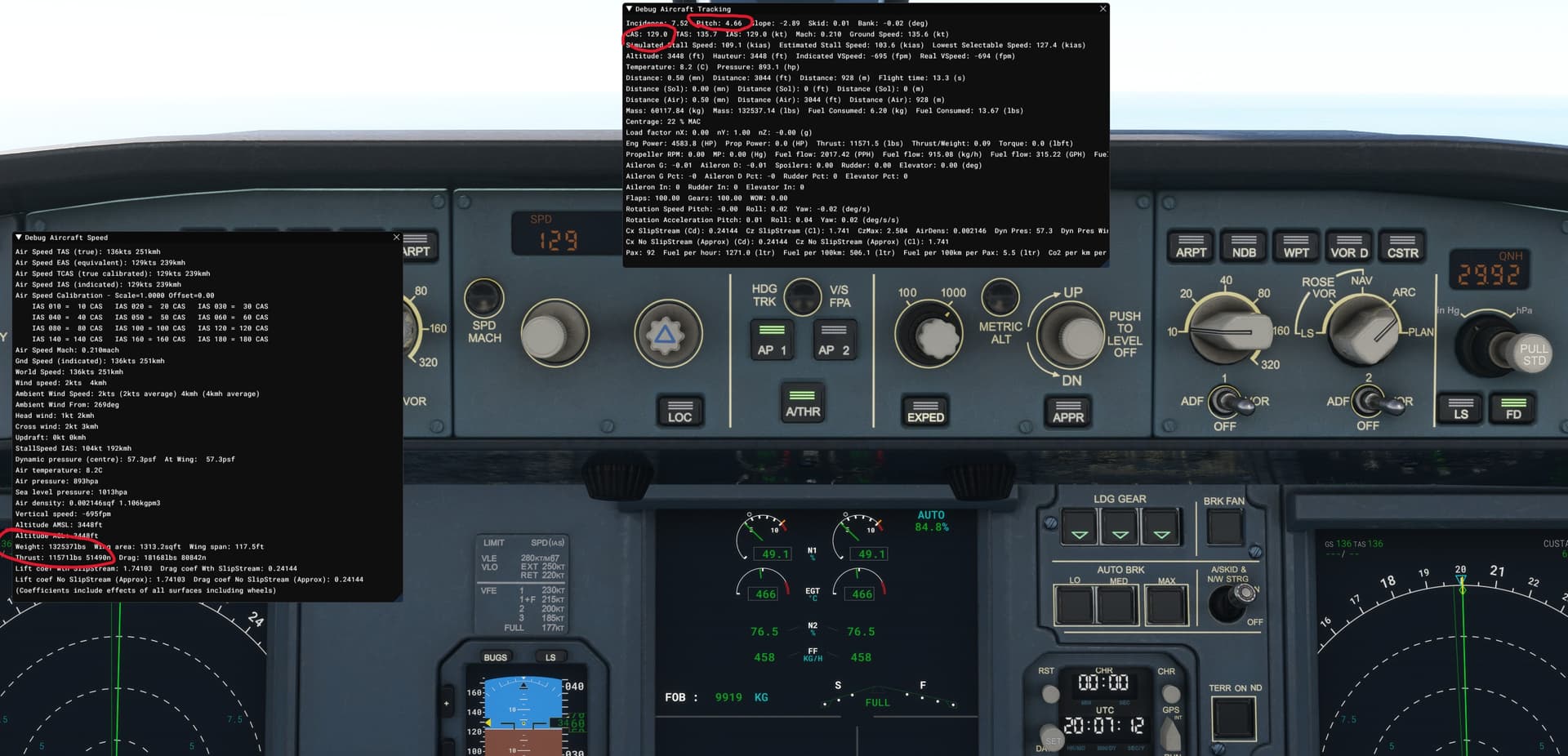
A bit more information on my issue(s). The “packages” are the dev version of the FBW A32NX and a modified dev version of the FBW A380X (fix(a380x/flight model): A380X Flight Model Update by donstim · Pull Request #9830 · flybywiresim/aircraft · GitHub). These are MSFS 2020 packages simply copied into the MSFS 2024 community folder.

It is the A380X where the flight model parameters I mentioned that resolved certain issues in 2020 (auto-rotation at takeoff and pitch-up/stall in flight) did not work the same way in 2024. I have since used a work around that did not require these parameters. However, I retained the StallDef_StartRatio, StallDef_EndRatio, Stall_AileronAddIncidence , and Stall_TipAddIncidence , and these appear (from the lift curve in the stall debug window) to now be working properly. I don’t know if the presence of the presspt parameters had caused them to not work properly or not, but they definitely were not working before.

For both airplanes, at higher flap settings, and particularly in landing configuration on a -3 degree glideslope, the pitch angles are different for the same packages in 2024 than for 2020.

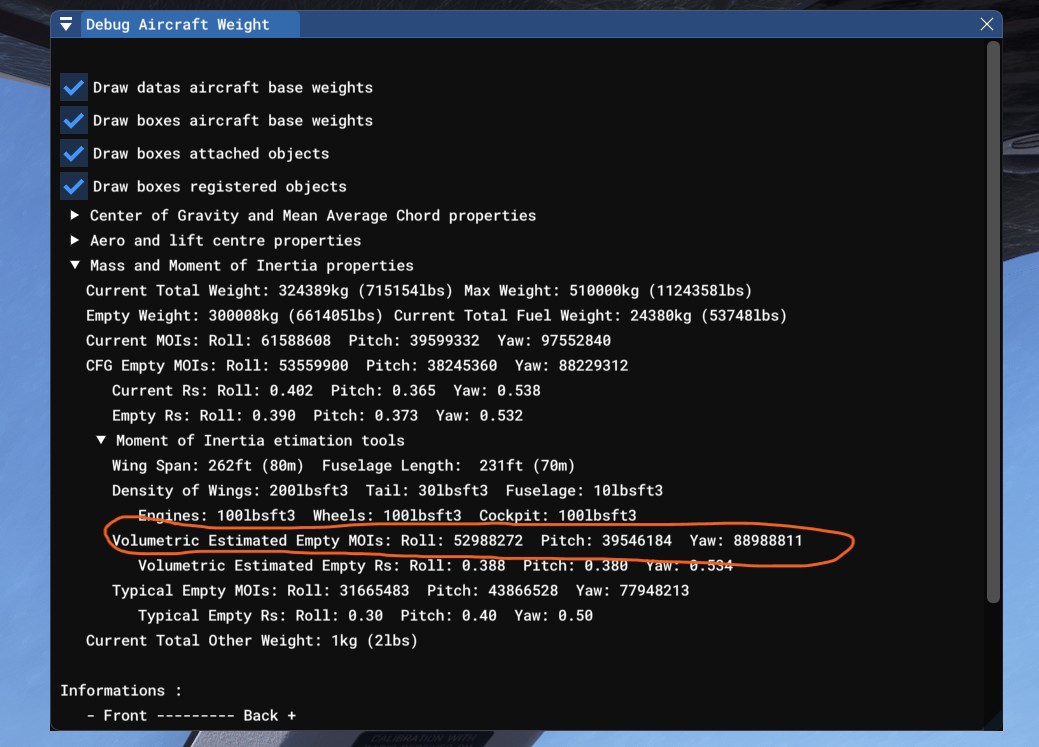
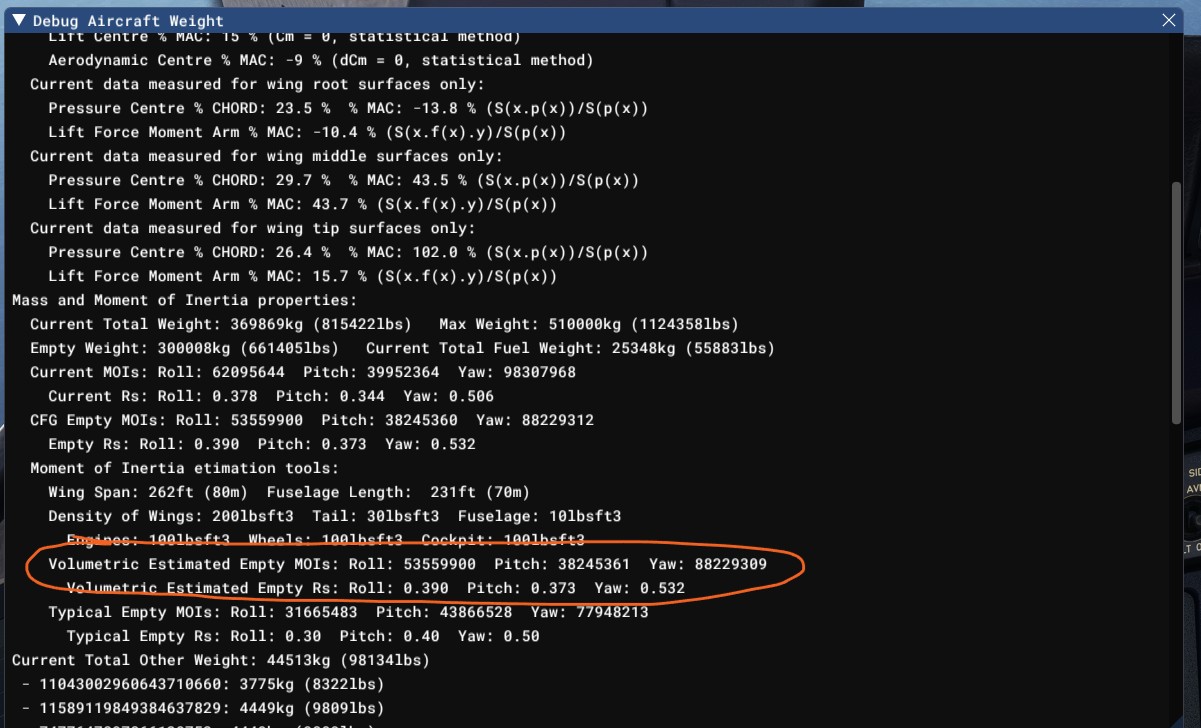
Oh, and one additional item. The volumetric estimated empty MOIs are just a bit different between 2022 and 2024 for the same package.


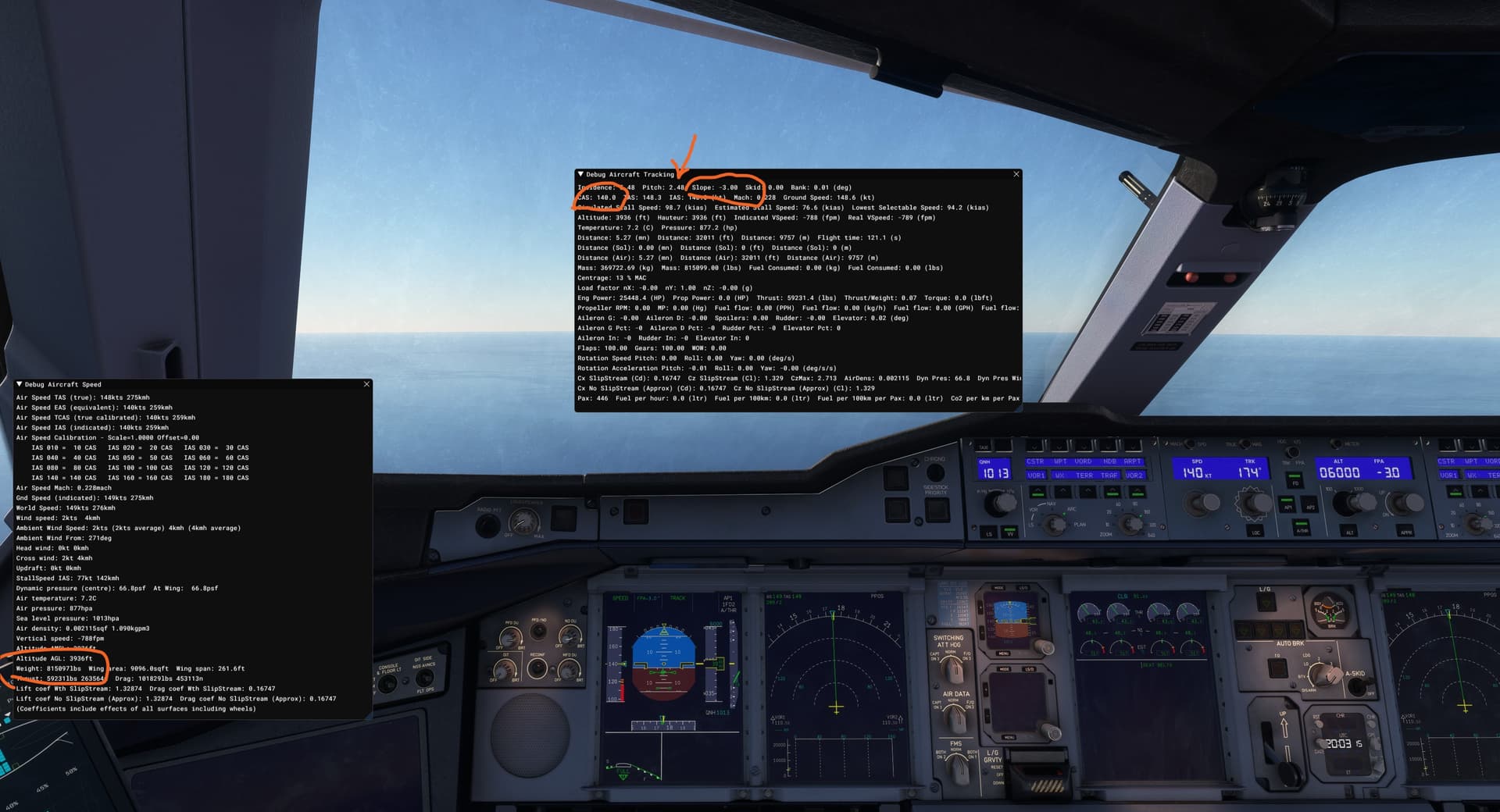
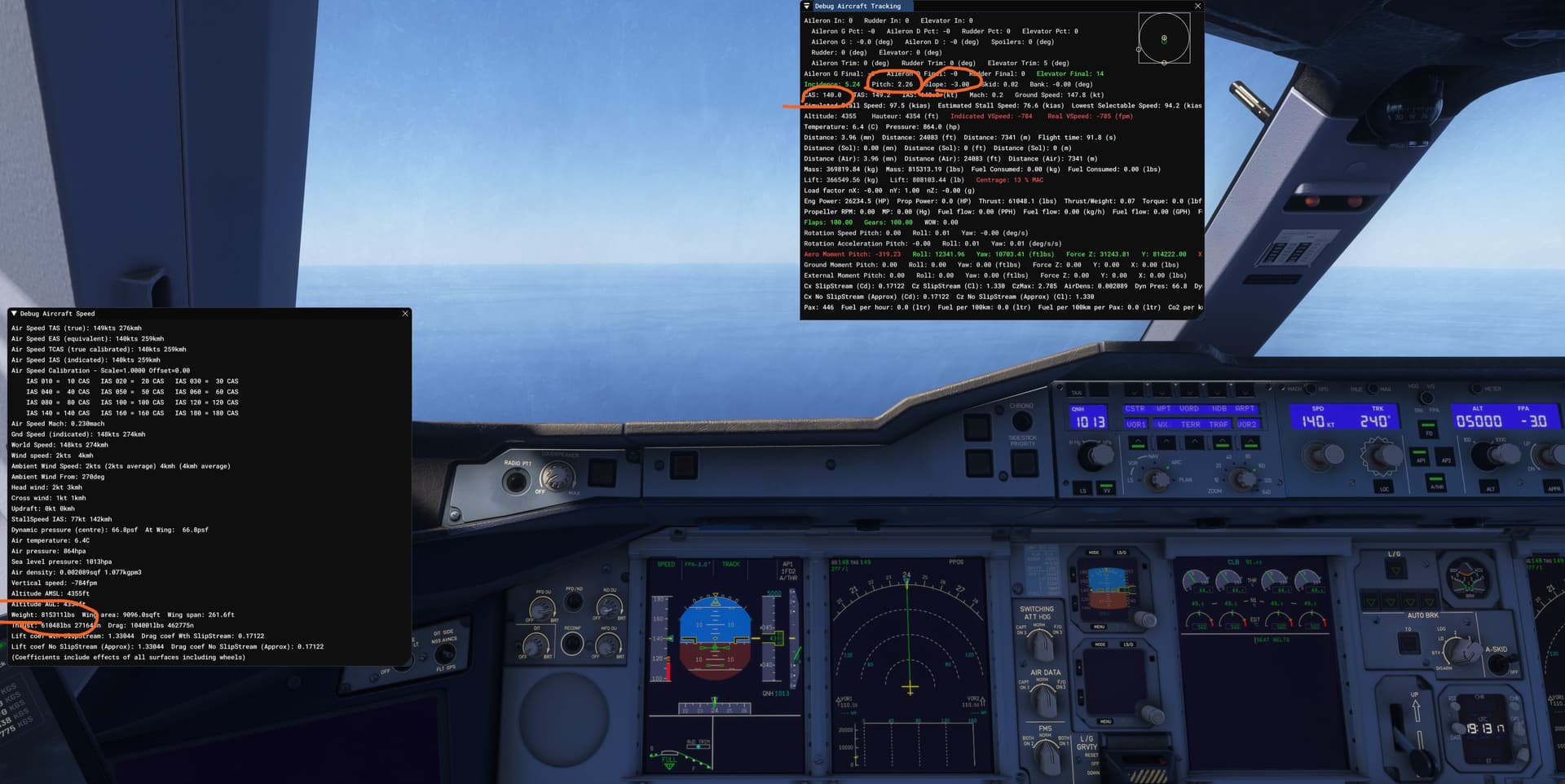
Here are examples of the pitch angle difference on the FBW A380X between MSFS 2020 and MSFS 2024 at the same weight and speed with full landing flaps and gear down on a -3 degree flight path angle (simulating a typical ILS approach).
MSFS 2020:

MSFS 2024:

2 Likes

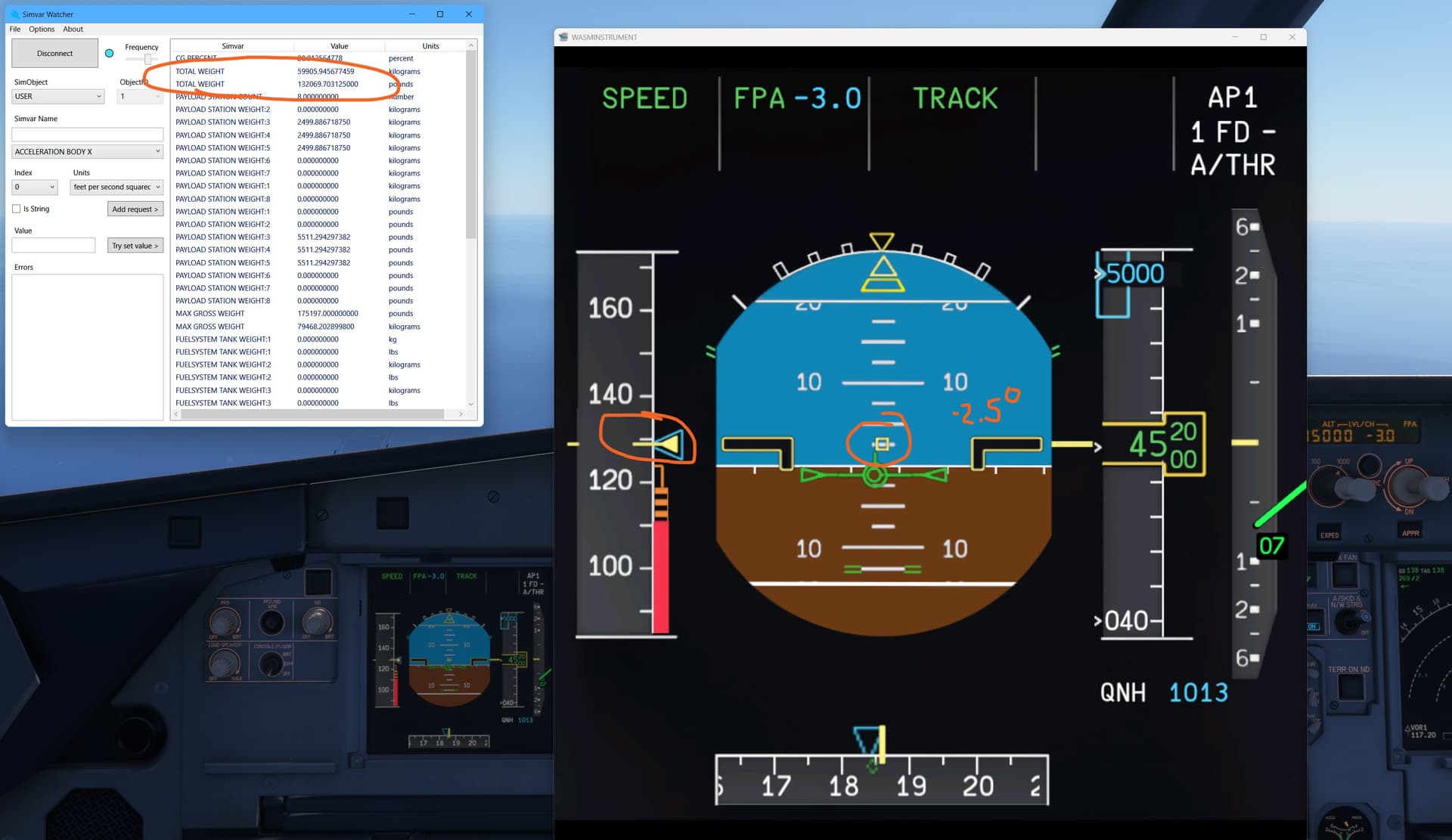
Tried to do the same comparison with the MSFS 2020 Asobo A320Neo, dropping it into the community folder in MSFS 2024. It would not let me show the dev debug windows in 2024, saying that the airplane is encrypted. But I think you can see from the PFD that the pitch difference between the 2 sims is there as well at full landing flaps, VAPP, -3 deg flight path angle.
MSFS 2020:
MSFS 2024:

Just bringing this up again since the issue still exists and there has not been any response. Are these known, expected difference between MSFS 2020 and 2024?

After 6 months of development on MSFS 2024 it is absolutely clear there are differences between the behaviour of the flight models, but I’m a bit dubious the differences can be nailed down to specific parameters. It looks like there may be macro changes to the way the flight model is being calculated - if I was to guess I think Asobo may have extended further how many ‘flat plates’ are being simulated to represent the shape of the aircraft pushing through the air and this can have significant effects, possibly with enhanced code to try and model interaction of the air flowing over multiple plates. As an example I’m guessing the movement of the control surfaces is modelled differently in MSFS 2024 and these can have more effect on the underlying lift and drag generation than before. The impact of this is most sensitive near the stall.

Unless the change really comes down to the tweak to a single parameter, I think it’s an impossible task to reverse-engineer what internal programming changes have made the two flight models different.

I’d prefer the flight models to be upwards-compatible, i.e. changes to the flight model only occur if you use new parameters. modern_fm_only = 1 was a good example. Alternatively, absolute clarity on the lack of backwards compatibility would be great as a ‘mostly similar’ flight model isn’t close enough to be treated as 100% compatible for some aircraft.

With MSFS 2024 it’s not clear if the flight model was changed on purpose, accidentally, or Asobo believes it hasn’t changed. I may have missed some crucial announcement though.

2 Likes

It is clear that there are not only flight behavior differences between MSFS2020 and MSFS 2024 flight models, but that some differences also result from different flight behavior effects of certain specific input parameters. After getting an initial response from Eric from Asobo, there has not been another official response even though I provided more information.

Any “guesses” as to why these differences exist by other developers are simply speculation. I would prefer someone from Asobo to say something like, “Thanks for your input, but we plan no further action on this issue,” “We did not expect these differences and are investigating further,” or “We expect to see such differences due to…”

As it stands, I think the only thing that developers can do is to realize that FS2024 flight models using MSFS 2020 inputs may not behave as in MSFS 2020, and that these flight models will need to be checked, verified, and tweaked as needed by trial and error (since there isn’t any information on why it should behave differently) in order to provide the desired result. The result is that an MSFS 2020 airplane used in MSFS 2024 will probably need a different flight model even if there is no intention to incorporate any of the additional capabilities provided by MSFS 2024.

2 Likes

This is the last remaining major item for the FlyByWire A32NX and A380X to be supported on FS2024 after SU3. Any progress on identifying and fixing the discrepancies?

1 Like

I have another example where a parameter works differently in the two sims for the FlyByWire A380X. We have an issue where at the FWD CG limit at light weights (so low takeoff speeds), the airplane is unable to rotate for takeoff until well above V2 speed. One fix is to increase the elevator effectiveness. An elevator effectiveness of 1.25 resolves the issue in FS2020, but not in FS 2024. It took an elevator effectiveness of 1.7 to achieve the same result in FS 2024.

Hello @AwarePlot117729,

If you change your aero_center_lift parameter in the flight_model.cfg (I see you have it set to 11 in the A380X), do you observe any change in pitch behavior in your aircraft in 2024, even with what would normally be large or absurd values that should cause big pitch moment changes?

Thanks,
Matt

Yes, of course I see pitch changes if I change the value of the aero_center_lift parameter. It doesn’t take large or absurd values to see it.

The reason I ask (specifically about 2024) is because in investigating this issue we are not able to see any behavior changes with a change to this value for our 2024 planes (Longitude, CJ4) whereas we see a very obvious pitch moment change in 2020, so I wanted to verify if you were likewise also seeing a lack of behavioral change on your end with that parameter in 2024, which might explain related issues you are seeing with rotation at Vr and also approach angle.

If I set the parameter to 0 in 2020, that seems to match (as best as I can tell) the behavior I see in 2024 with the param at any value, which may imply the value is getting discarded somewhere along the way.

Thanks,
Matt

Hi Matt,

Sorry for the slow response. No, I’m not seeing what you are. I’d love to start a separate thread about pitch/trim/cg issues and how to address takeoff auto-rotation throughout the takeoff weight/cg envelope while also having correct trim values in flight at various conditions.

But to get back to your specific question, that’s not an issue I am seeing. If I change the aero_center_lift value from 11 to, for example, 6, I see very definite changes in pitch angle for a given steady-state flight condition as well as auto-rotation speed for a given weight/cg.

Here are the steady pitch angle comparisons, done at landing flap, VAPP, on a -3 deg flight path angle. First, with aero_center_lift of 11, the resulting pitch angle is 2.16 degrees. (In MSFS 2020, with the same flight_model.cfg file, the pitch angle is 2.50 degrees. Hence, one of the reasons for my initial post. We would need a different flight model for the A380X for MSFS 2024 than for MSFS 2020 just to retain the same flight performance accuracy, not even trying to take advantage of any specific MSFS 2024 flight model features. This isn’t as big of an issue with our A32NX, and is, I believe, due to some of the differences in the effects of certain MSFS 2024 parameters I had to use to address auto-rotation and excessive pitch-up issues on the A380X.)

With aero_center_lift set to 6, the pitch angle for the same condition is 2.49:

For the takeoff auto-rotation issue, for the same takeoff weight and cg condition, the auto-rotation occurred at 153 KCAS with aero-center_lift set to 11 and 159 KCAS with it set to 6. (I am defining auto-rotation speed as the speed at which the nose wheel is completely detached from the ground per the “wheel” dev window.) Here is a video for aero_center_lift = 11:

A380X MSFS 24 Aero Center 11.mp4

And here it is with aero_center_lift = 6:

A380X MSFS 24 Aero Center 6.mp4

Hope this is of use to you,
Don

1 Like

Do you get the same auto-rotation speeds using these identical settings under 2020? We (WT) are not, but also trying to confirm if the issue is a build issue and the numbers aren’t applying during our testing somehow. It would be helpful to know if other folks are seeing a difference in pitch moment with the same settings for aero_center_lift between the simulators or if we’re just hallucinating it over here on our end.

Thanks,
Matt

My initial reaction would be no, the auto-rotation speeds, as with other pitch-related parameters, would be different for MSFS 2020. (See, for example, Flight Model aero parameters working in MSFS 2020, but not in MSFS 2024 - #13 by AwarePlot117729 ).

However, the results did not support this expectation. At aero center = 11, the auto-rotation speed for MSFS 2020 at KLAX at 370 T was about 148 KCAS compared to 153 KCAS for MSFS 2024. However, the nose wheel came back down onto the runway and then departed again at 154 KCAS. Repeating the same test at KSEA, the nose wheel left the runway at 154 KCAS. At aero center = 6, the nose wheel left the runway at 159 KCAS in both MSFS 2020 and MSFS 2024.

We had auto-rotation as well as sudden, excessive, and unrecoverable pitch-up with the A380X early on in MSFS 2020. After successfully addressing these issues in MSFS 2020, I found that the solutions for MSFS 2020 did not work for MSFS 2024. That is what precipitated my opening of this thread. The final resolution that worked for both but still needs some different flight model inputs for MSFS 2024 was to use a much more forward CG position for MSFS flight dynamics than is shown in the airplane displays.

I am now considering using a similar method in our A32NX (different MSFS and displayed CG positions) to allow proper airplane rotation characteristics throughout the weight/CG/trim envelope and correct trim indications in flight. Unlike some other airplanes out there, we use an expanded CG envelope for our airplane and allow the user to load passengers and cargo as they wish in terms of forward or aft. Neither MSFS 2020 nor 2024 seem to allow this to be done accurately with normal use of the flight model inputs.